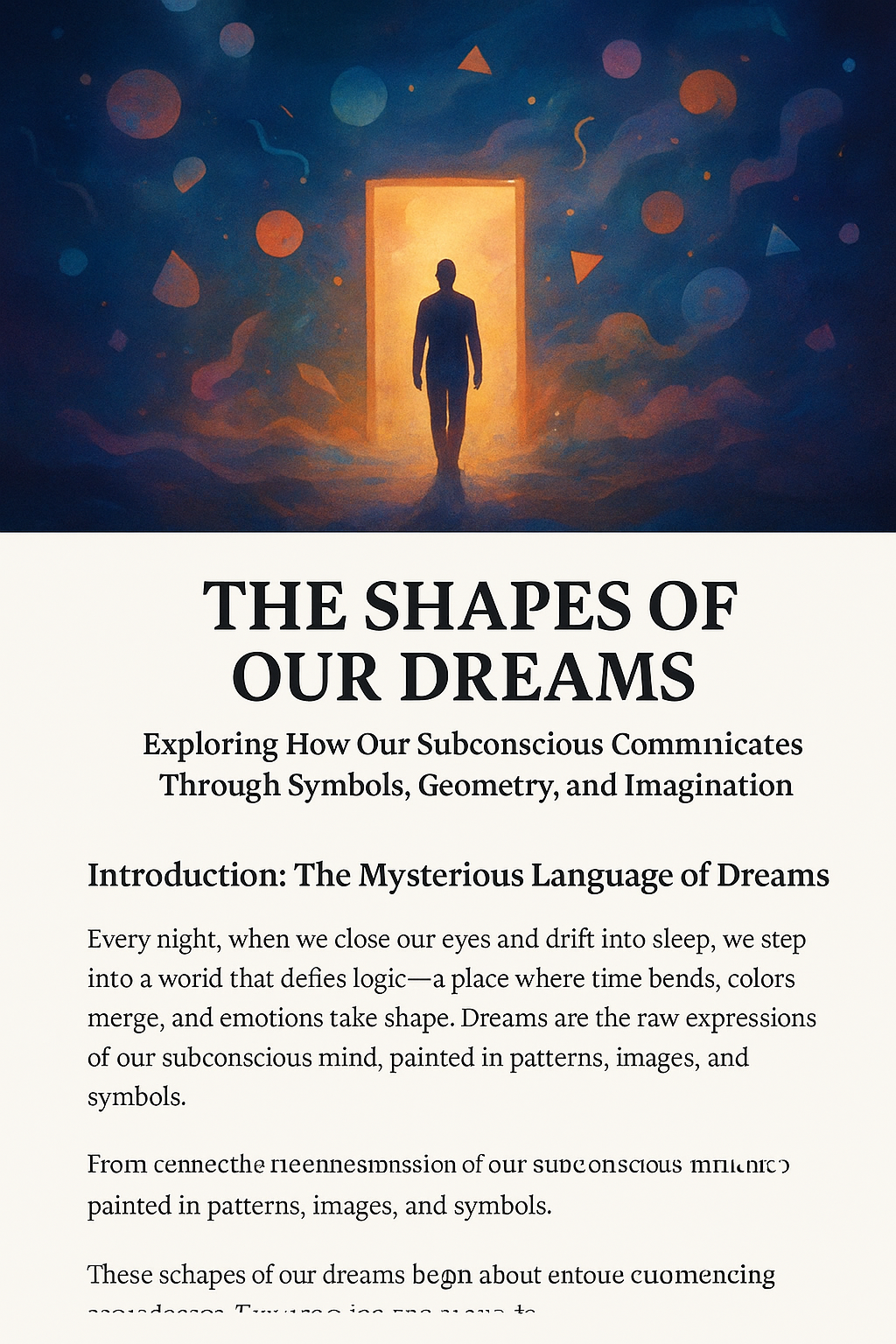
Exploring How Our Subconscious Communicates Through Symbols, Geometry, and Imagination
Introduction: The Mysterious Language of Dreams
Every night, we drift into a world beyond logic — a world where time dissolves, reality bends, and feelings take shape. This world is our dreamscape. Here, emotions become colors, thoughts become patterns, and fears become forms. These “shapes” are not random; they are coded messages from our subconscious mind.
Dreams reveal more about us than we often realize. They show what we fear, what we long for, and what we’ve ignored. The shapes, symbols, and imagery we see in dreams can unlock powerful insights into our personal growth and emotional well-being.
In this article, we’ll explore how the science of dreaming intersects with psychology, symbolism, and self-improvement — showing you how the shapes of your dreams can guide your waking life.
The Science of Dreams
1. What Happens When We Dream?
Dreaming occurs mainly during the REM (Rapid Eye Movement) stage of sleep. During this phase, brain activity spikes, resembling the same patterns seen when we’re awake. Our eyes move rapidly behind closed lids, and vivid imagery unfolds in our minds.
According to research from the National Institute of Neurological Disorders and Stroke, dreams play a role in memory consolidation, emotional regulation, and problem-solving.
2. Why Do We Dream? The Major Theories
- Freud’s Psychoanalytic Theory
Sigmund Freud suggested that dreams are expressions of our hidden desires and unresolved conflicts. In his book The Interpretation of Dreams (1899), he explained that dreams disguise repressed thoughts through symbols. - Jung’s Analytical Theory
Carl Jung believed dreams are not just personal but universal. He introduced the idea of archetypes — shared symbols across humanity that express deep psychological truths. - Activation-Synthesis Model (Hobson & McCarley, 1977)
This modern neuroscience theory suggests that dreams are the brain’s way of making sense of random neural activity. However, the meaning we attach to those random images can still reflect our inner emotions. - Continuity Hypothesis (Schredl, 2003)
According to this idea, dreams mirror our waking-life experiences. What we think, feel, and worry about often appears in symbolic form in our dreams.
Shapes, Symbols, and the Subconscious
Our subconscious communicates in images, not words. Shapes and symbols act as emotional shortcuts. For example:
- Circles often represent unity, wholeness, or comfort.
- Triangles may indicate conflict, ambition, or transformation.
- Squares can symbolize structure, stability, or feeling “boxed in.”
- Spirals represent growth, cycles, or spiritual evolution.
- Irregular or broken shapes can reveal confusion, instability, or emotional disruption.
These symbols can appear as literal objects — like wheels, pyramids, or windows — or as abstract visuals that evoke particular feelings.
Carl Jung described such shapes as part of the “collective unconscious.” For example, a circle (the mandala) often symbolizes the quest for balance and self-integration.
The Geometry of Dreams
Dreams often express meaning through geometry — not just in shapes, but in how things are arranged.
- Symmetry in dreams may reflect inner balance or harmony.
- Distorted or melting shapes (as in Salvador Dalí’s art) may represent confusion or time distortion.
- Repetitive shapes or patterns can indicate obsessive thoughts or unresolved habits.
A 2019 study in Frontiers in Psychology found that people who frequently dream of structured, geometric patterns often have higher creative cognition. Dreams, in this sense, become a workshop for the imagination.
Dreams and Self-Improvement: Turning Symbols into Insight
Dreams are more than nighttime entertainment — they’re mirrors of your mind. If interpreted with awareness, they can become powerful tools for self-growth.
1. Dream Journaling
Keep a notebook by your bed. Write down dreams immediately upon waking, noting shapes, colors, and feelings. Over time, patterns emerge. Maybe triangles appear whenever you’re stressed about career goals — a sign of inner conflict between ambition and peace.
2. Emotional Reflection
Ask yourself:
- What emotion did this shape or dream evoke?
- Does this shape remind me of something in my waking life?
- Is there a recurring shape or symbol that might point to a personal theme?
3. Connecting Shapes to Actions
- Dreaming of closed shapes (like cages or boxes) → You may need to break free from limiting beliefs.
- Dreaming of open or circular shapes → You’re ready to embrace change or new beginnings.
- Dreaming of chaotic, shifting forms → Reflects inner turbulence or creativity needing expression.
By connecting these insights to daily life, you begin to use your dreams as tools for emotional clarity and decision-making.
How Waking Life Shapes Our Dreams
Dreams don’t exist in isolation. According to the Continuity Hypothesis, your waking experiences shape your dream content.
- Stress, anxiety, and fatigue can produce chaotic or dark shapes.
- Peace, contentment, and gratitude often produce bright or harmonious imagery.
- Repressed emotions may appear as distorted, fragmented shapes or endless mazes.
A study from the University of Montreal (2014) found that people with higher emotional awareness experience more vivid, colorful dreams — suggesting that dream clarity mirrors emotional intelligence.
The Role of Emotions and Memory
Dreams serve as a mental reset. The Amygdala (the brain’s emotional center) remains active during REM sleep, while the Prefrontal Cortex (logic center) quiets down.
This combination allows us to process emotions safely through symbolic visuals — often as shapes or narratives. By understanding what your dream shapes express emotionally, you can identify what your mind is healing or avoiding.
Harnessing the Power of Dream Shapes for Growth
1. Identify Recurring Shapes
Pay attention to patterns. Are certain shapes repeating across nights?
Example: A recurring staircase or spiral could indicate ongoing personal evolution or a struggle to move forward.
2. Use Meditation and Visualization
Before sleeping, visualize a calm geometric form — such as a circle or light sphere. This practice (known as dream incubation) helps your subconscious focus on balance and clarity.
3. Interpret Without Over-Analyzing
Not every dream symbol carries deep meaning. Use shapes as emotional signposts — not fortune-telling tools. The goal is self-understanding, not prediction.
4. Translate Dreams Into Action
If you dream of collapsing structures, it may suggest instability — perhaps it’s time to strengthen certain areas of life.
If you dream of bright open spaces, maybe you’re ready for expansion — a new opportunity or mindset shift.
Limitations and Cautions
While dream interpretation is insightful, it’s not an exact science.
Even experts like Jung emphasized that meaning depends on personal context.
- The same shape may mean different things to different people.
- Cultural background affects dream imagery.
- Some dreams may simply be the brain’s creative byproduct, not messages.
Use dream reflection as a tool, not a rulebook.
Dreams, Creativity, and Innovation
Many groundbreaking ideas were born in dreams:
- Paul McCartney dreamed the melody of “Yesterday.”
- Dmitri Mendeleev saw the periodic table arrangement in a dream.
- Elias Howe invented the sewing machine after dreaming of needles with holes at their tips.
The link between dreams and creativity shows that these symbolic shapes are not just reflections — they can be inspirations.
Dreams are where your subconscious experiments freely. The more you understand them, the better you harness your creativity and self-awareness.
Conclusion: The Architecture of the Soul
The shapes of our dreams are the architecture of our inner world. They reflect our fears, hopes, and transformations. Circles of unity, triangles of ambition, spirals of growth — each form tells a story about who we are and who we are becoming.
When we learn to read this silent geometry, we open a dialogue with the deepest parts of ourselves. Our dreams, once seen as mysteries, become maps — guiding us toward balance, creativity, and emotional freedom.
So tonight, as you close your eyes, remember: the shapes you see are more than imagination. They are reflections of your evolving soul — your mind’s way of sketching its journey toward wholeness.
References & Sources
- Freud, S. (1899). The Interpretation of Dreams.
- Jung, C.G. (1964). Man and His Symbols.
- Hobson, J.A., & McCarley, R.W. (1977). The Brain as a Dream Generator: An Activation-Synthesis Hypothesis.
- Schredl, M. (2003). Continuity Hypothesis in Dreams.
- Frontiers in Psychology (2019). Dreams and Creativity: A Cognitive Neuroscience Perspective.
- University of Montreal (2014). Emotional Intelligence and Dream Vividness Study.